The Short Version
- An atmospheric water generator, or AWG, pulls water vapor out of the air, condenses it, and collects and treats the water.
- Output depends on humidity and temperature. Warm, humid air yields the most water. Cold or very dry air yields much less.
- Making water from air takes a lot of power, which is why pairing an AWG with solar and battery matters off-grid.
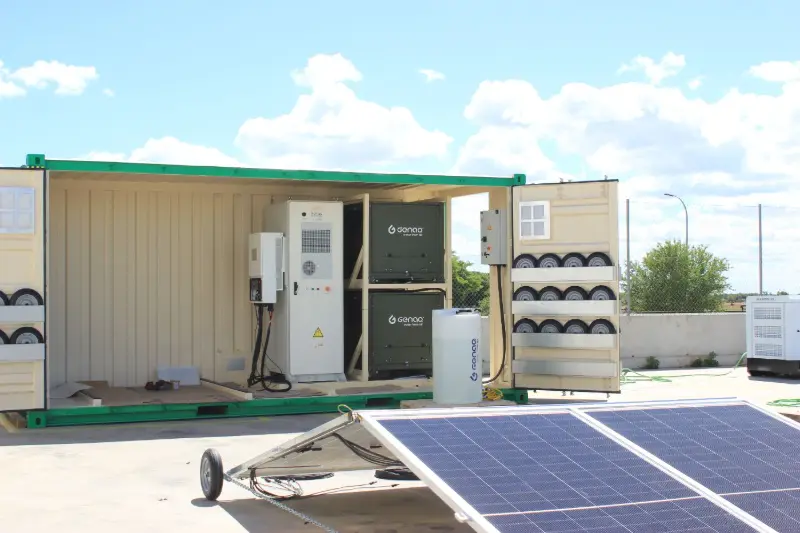
- The Nomad Energy Water makes up to 264 gal per day, depending on humidity. It runs off-grid on its own solar array and battery, and can tie into diesel or grid power where either is on site.
What an Atmospheric Water Generator Is
Air always carries some water as vapor, even in places that look dry. An atmospheric water generator, often shortened to AWG, is a machine that pulls that vapor out of the air and turns it into liquid water. It uses the same physics that fogs a cold glass on a summer day or drips water from an air conditioner, engineered to collect the water on purpose and treat it for use.
That makes an AWG a water source that goes where the equipment goes. It needs no well, no pipeline, and no water delivery. It needs air, power, and time.
How It Pulls Water From the Air
Most AWGs work by cooling condensation. The process runs in four stages:
- Draw in air. A fan moves outside air through the system.
- Cool it below the dew point. The air passes over a cold surface chilled by a refrigeration circuit. Once the air cools below its dew point, the temperature at which it can no longer hold all its water vapor, the vapor condenses into droplets.
- Collect the condensate. The droplets run off the cold surface into a collection tank.
- Filter and treat. The water is filtered and treated before it goes to storage and use. Treatment steps vary by system and by how the water will be used.
A second family of AWGs uses desiccants: materials that absorb moisture from the air and release it when heated, after which it is condensed. Desiccant systems are often considered for drier climates but need heat to regenerate the material. Either way, the system spends energy to make water, and that is the key to planning one.
Why Humidity Drives Output
How much water an AWG can make depends on how much water the air actually holds, and how much work it takes to get it out. Two measurements matter.
Relative humidity is how close the air is to saturation, as a percentage. Temperature sets how much water the air can hold in the first place: warm air holds far more vapor than cold air. Together they set the dew point. The higher the dew point, the more water the air carries and the more each pass of air can give up. The closer the air is to its dew point, the less cooling it takes to start condensing.
That leads to a few practical rules:
- Warm and humid is best. Coastal, tropical, and humid inland sites give the most water for the energy spent.
- Hot and dry yields less. Desert air can be hot but carry little water, so the system has to cool it much further to reach the dew point, and output falls.
- Cold air yields little. Cold air holds little water to begin with, even at high relative humidity.
- Output moves through the day and the year. Relative humidity often rises at night as the air cools, and the seasons shift both temperature and humidity.
This is why an AWG output figure means little without the conditions behind it. A rated figure usually describes warm, humid air. Real daily output at your site depends on your local climate across the months you need water. Real daily output at your site depends on your local climate across the months you need water.
Reading an Output Figure
The Nomad Energy Water makes up to 264 gal per day, depending on humidity. Read "up to" literally: it is the output in favorable conditions, not a guaranteed daily volume. In drier or colder weather, or with less sun when it runs off-grid, the same system makes less.
When you compare systems, ours included, ask what conditions an output figure assumes, and ask for an estimate at your own site's humidity and temperature across the year. Plan your supply around the months you need water most, not the best month on record. Include your location in your request so the brief can address expected output for your climate.
Storage and Water Quality
Making the water is half the job. Like any water supply, water made on site needs clean storage, regular checks, and a plan for who maintains the filters and treatment. Sealed tanks, a routine for testing, and spare filters on hand keep the supply dependable.
Ask how treatment works on any system you consider, and test the water against the standard your use requires. Drinking, cooking, and equipment cooling can each call for different treatment, so state the use in your request.
Why Power Is the Hard Part
Condensing water takes a lot of energy. A refrigeration circuit runs for as long as the system makes water, and in drier air it has to work harder for each gallon. Off-grid, that energy usually comes from a diesel generator, so part of the delivery problem comes back: fewer water trucks, but a fuel line to keep supplied.
The Nomad Energy Water pairs its onboard atmospheric water generators with their own power: a 54.7 kWp solar array and a 61.44 kWh battery in one container. Solar and battery run the system off-grid. On solar and battery alone, daily output depends on the sun at your site as well as the humidity, and the battery sets how long it runs after dark. Where diesel or grid power is already on site, the Water can tie into it as well, so you can run it off-grid where there is nothing and connect it where there is.
Like the Box 20 and Box 10, it arrives pre-wired and factory-tested, moves by truck, is placed by crane or forklift, and needs no trenching, foundations, or civil works. Typical deploy for the Water is under 3 hours from arrival, depending on the site. Typical deploy is under 3 hours from arrival, depending on the site.
| System | Solar | Battery | Water | Typical Deploy |
|---|---|---|---|---|
| WaterContainer with onboard water generation | 54.7 kWp | 61.44 kWh | Up to 264 gal per day, depending on humidity | Under 3 hours |
Where Water From the Air Fits
An AWG earns its place where water is hard to deliver, or where the delivery itself is the risk:
- Emergency response after storms, floods, and fires, when water systems are down and roads are cut.
- Humanitarian operations and remote communities without reliable water.
- Defense positions where every water delivery is another convoy to plan and protect.
- Remote work camps and mining and energy sites at the end of long haul roads.
It works best as part of a water plan, not the whole plan. Match AWG output to a share of daily demand, keep storage on site to smooth the swings, and keep a delivery option for the driest weeks.
Questions to Answer Before You Deploy
- How much water do you need each day, and how much of it could come from the air?
- What is the climate across the deployment? Humidity and temperature by month, not just the annual average.
- What power is on site? Off-grid solar, a generator, the grid, or a mix.
- How much storage will you keep? Storage carries the site through low-output days.
- How long is the deployment, and will the system move with the mission?
Send those answers with your request. Your brief covers the system, transport and site logistics, and pricing to purchase, lease, or rent. For the power side of the site, see solar vs diesel generators.