The Short Version
- Operational energy is the energy needed to train, move, and sustain forces. At a forward operating base, generator fuel is a large and constant part of it.
- Every gallon not burned is a gallon that does not have to be convoyed, guarded, and delivered.
- Three levers cut base fuel: use less, run generators better, and make power on site.
- Solar and battery systems make power where the base stands, with no engine noise and no exhaust at the power source.
What Operational Energy Means
The Department of War divides its energy use in two. Installation energy runs permanent bases. Operational energy is the energy needed to train, move, and sustain forces and weapons platforms for military operations: fuel for vehicles and aircraft, and the power that runs expeditionary sites in the field.
At a forward operating base, most of that power comes from diesel generators. They run tactical operations centers, communications, lighting, refrigeration, water treatment, and the heating and cooling that keep people and equipment working. They run around the clock, and every gallon they burn travels the same supply line as everything else the base needs.
Why Fuel Is the Burden
Fuel is heavy, bulky, and constant. A base does not order it once; it burns it every day, so resupply never stops. Each run ties up vehicles, drivers, and security that the mission needs somewhere else. Each run is exposed on the road. And when the fuel line is contested or cut, the generators stop with it.
Count the convoy, the protection, and the risk, and a gallon delivered forward costs far more than a gallon at the depot. That is why cutting fuel demand at the edge is an operational question, not just a cost line.
Generators also give a position away. A running engine is loud and throws hot exhaust, an acoustic and thermal signature that cannot be switched off without losing power.
Where Generator Fuel Gets Wasted
Not every gallon burned is a gallon of useful power. Expeditionary generators are often sized for the largest load the site might ever draw, then run for hours at a fraction of it. Diesel generators burn more fuel per kWh at light load, and long runs at light load can cause wet stacking, unburned fuel building up in the exhaust, which adds maintenance on top of the waste.
Spread a base across many small generators, each running its own cluster of loads at light load, and the waste compounds. The fuel bill, and the convoy schedule, end up driven partly by how the power is produced rather than by how much power the base needs.
Three Ways to Cut Fuel at the Base
1. Use less
Efficient lighting, insulated shelters, and better-managed heating and cooling cut the load before any generator is involved. Every kWh the base does not need is fuel it does not have to receive.
2. Run generators better
Connecting generators into a shared grid, often called a microgrid, lets fewer generators run at a healthier load while others stand by. Right-sizing and load management cut the light-load waste described above.
3. Make power on site
Solar makes power where the base stands, from a fuel source that needs no convoy. With a battery, it carries the night as well. Solar does not replace good energy discipline or a well-run generator fleet. It adds to them: every kWh solar delivers is one the generators do not have to make.
At the planning figure our savings calculator uses, about 12 kWh of electricity per gallon, every 12 kWh of solar your loads use is roughly one gallon that does not have to be convoyed forward.
Matching the System to the Site
Forward sites range from a small team at an observation post to a base camp with hundreds of people. The Nomad Energy lineup scales the same way:
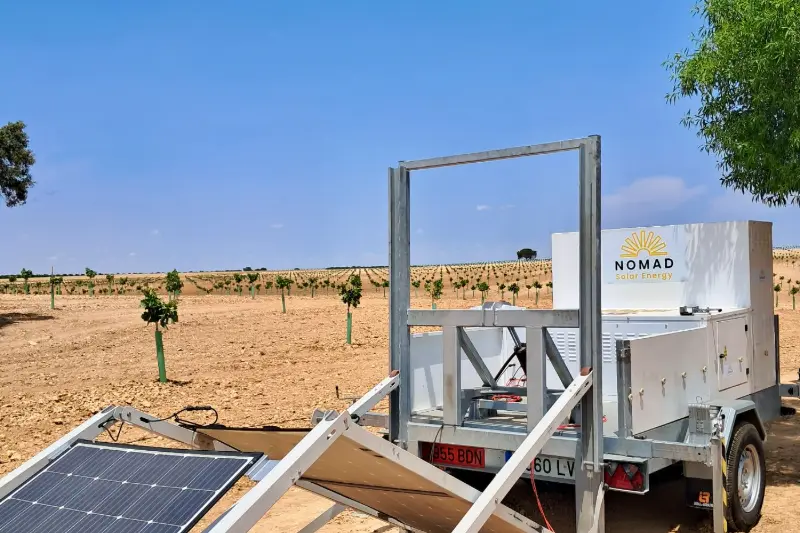
- Tow: a towable trailer for small and dispersed teams. It moves behind a suitable tow vehicle, and typical deploy is 30 minutes.
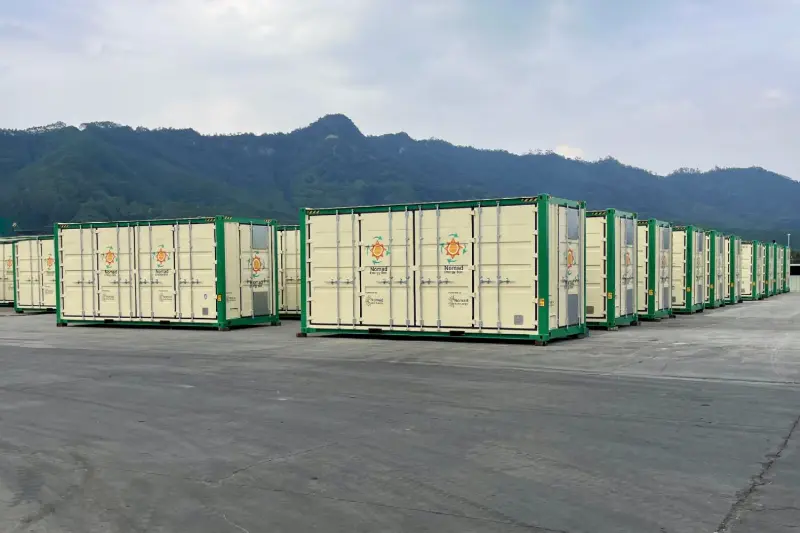
- Box 10: a 10-foot container that moves by truck and is placed by crane or forklift, deployed with Grupo Amper at BACSI, a Spanish Air and Space Force exercise for defense technology. Typical setup is under an hour with two operators.
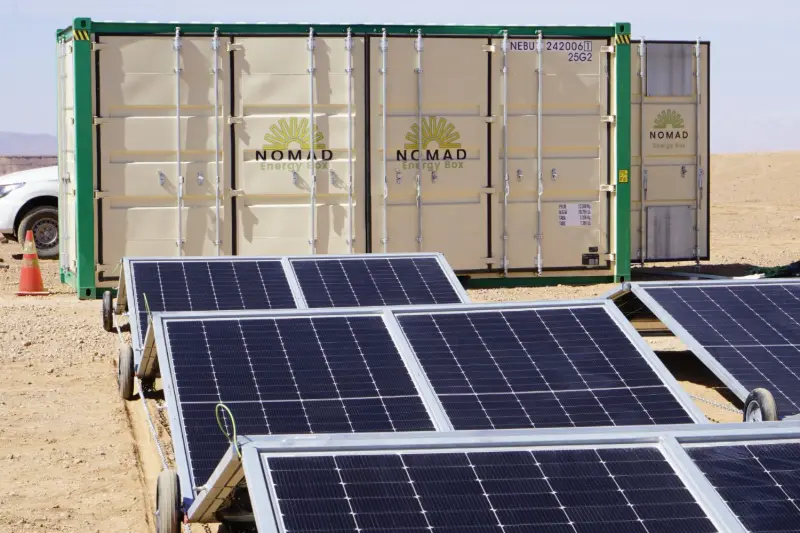
- Box 20: the flagship 20-foot ISO container for larger base camps, with the most solar per container. Typical deploy is under 3 hours.
- Water: atmospheric water generation for sites where water resupply is part of the problem, making up to 264 gal per day, depending on humidity. It runs on its own solar and battery and can tie into diesel or grid power, and off-grid output also depends on the sun.
Every system arrives pre-wired and factory-tested, and needs no trenching, foundations, or civil works. Nomad Solar Energy, which builds them, is an ISO 9001:2015 certified manufacturer.
| System | Solar | Battery | Typical Deploy |
|---|---|---|---|
| Box 20 HybridSolar + onboard battery | 78.54 kWp | 122.88 kWh | Under 3 hours |
| Box 20 PowerSolar only. Pairs with generators or storage | 107.1 kWp | None | Under 3 hours |
| Box 10 HybridSolar + onboard battery | 23.8 kWp | 61.44 kWh | Under an hour, two operators |
| Box 10 PowerSolar only. Pairs with generators or storage | 47.6 kWp | None | Under an hour, two operators |
| TowTowable trailer, about 3,300 lb | 12 kWp | 20.48 kWh | 30 minutes |
Hybrid or Power at a Forward Site
The Box 20 and Box 10 each come in two versions, and the choice follows the night.
Hybrid stores daytime solar in an onboard battery, so the position keeps power after sunset with no engine running. Choose it when signature discipline matters at night, or when there is no generator to pair with.
Power is solar only, with no battery, and carries more solar in the same container. It pairs with the generators or storage already fielded: solar takes part of the daytime load, so the generators burn less fuel. With no battery, a generator or storage unit stays on beside it through the day, and the night load stays on them. Choose it when the generators are already there and the goal is to shrink their fuel demand.
Many bases will use both. Your brief sets the mix for each site. For a fuller comparison, see solar vs diesel generators.
Estimating What a Site Could Save
Start from the fuel logs. The gallons each site burns per day are the best measure of its load. Enter them in the savings calculator with the sun for the region, and it estimates the gallons a system could offset each year, with every assumption shown and editable. Then read how to size a mobile solar generator to check the estimate against peak load, battery, and night load.
Be clear about which loads can move. Lighting, communications, and charging suit solar well, because much of that load runs by day or fits in a battery. Large heating and cooling loads that peak at night lean harder on the battery or the generator. Splitting the two in the fuel logs, where you can, gives a sharper estimate.
Treat the result as a planning estimate, not a performance guarantee. Real output moves with season and weather, and generators run less efficiently at light load. An engineer checks the numbers against the site in your brief.
How to Acquire
Every platform is available to purchase, lease, or rent: purchase for permanent sites and long programs, lease to keep capital free, rent for an exercise or a short deployment. Every brief covers pricing for all three, transport and site logistics, supply-chain origin, warranty and U.S. service, and lead time to deploy, with an engineering review typically within one business day.
For more on expeditionary power for Department of War sites, see the defense page.